
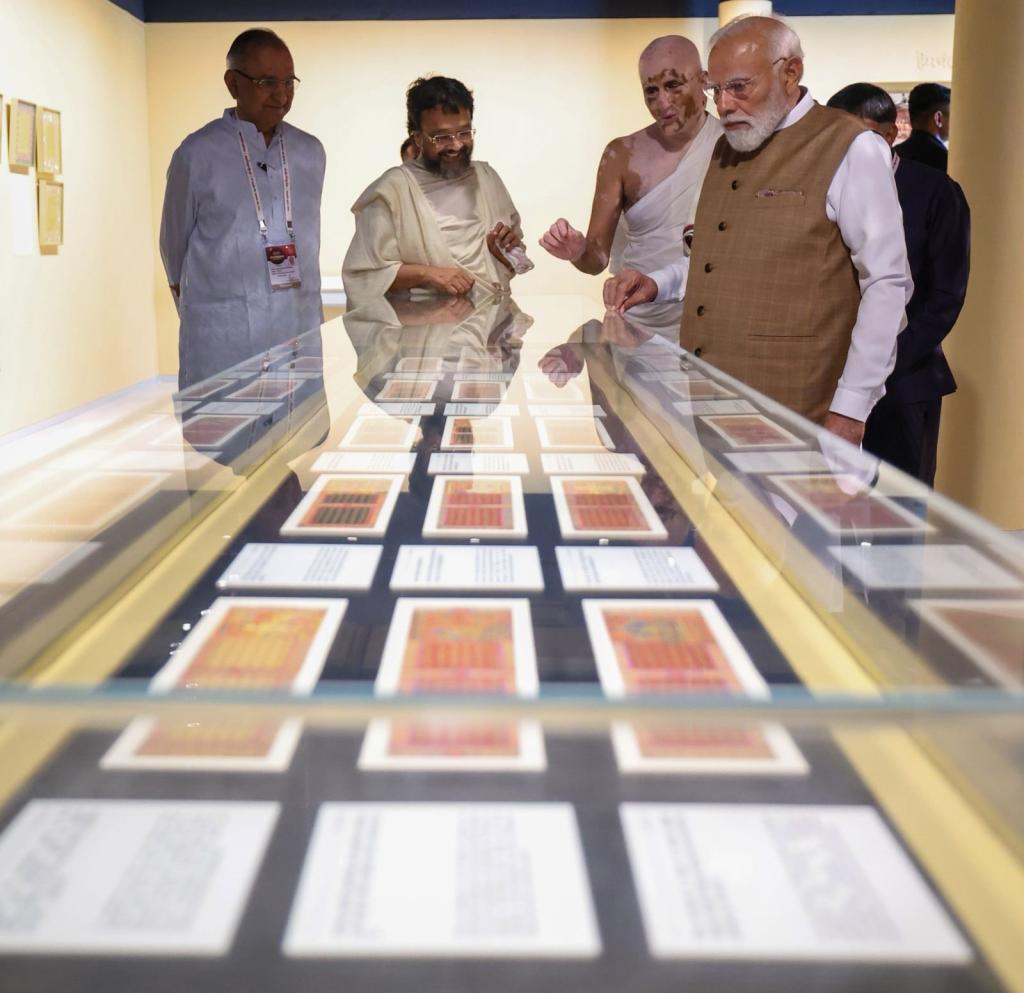
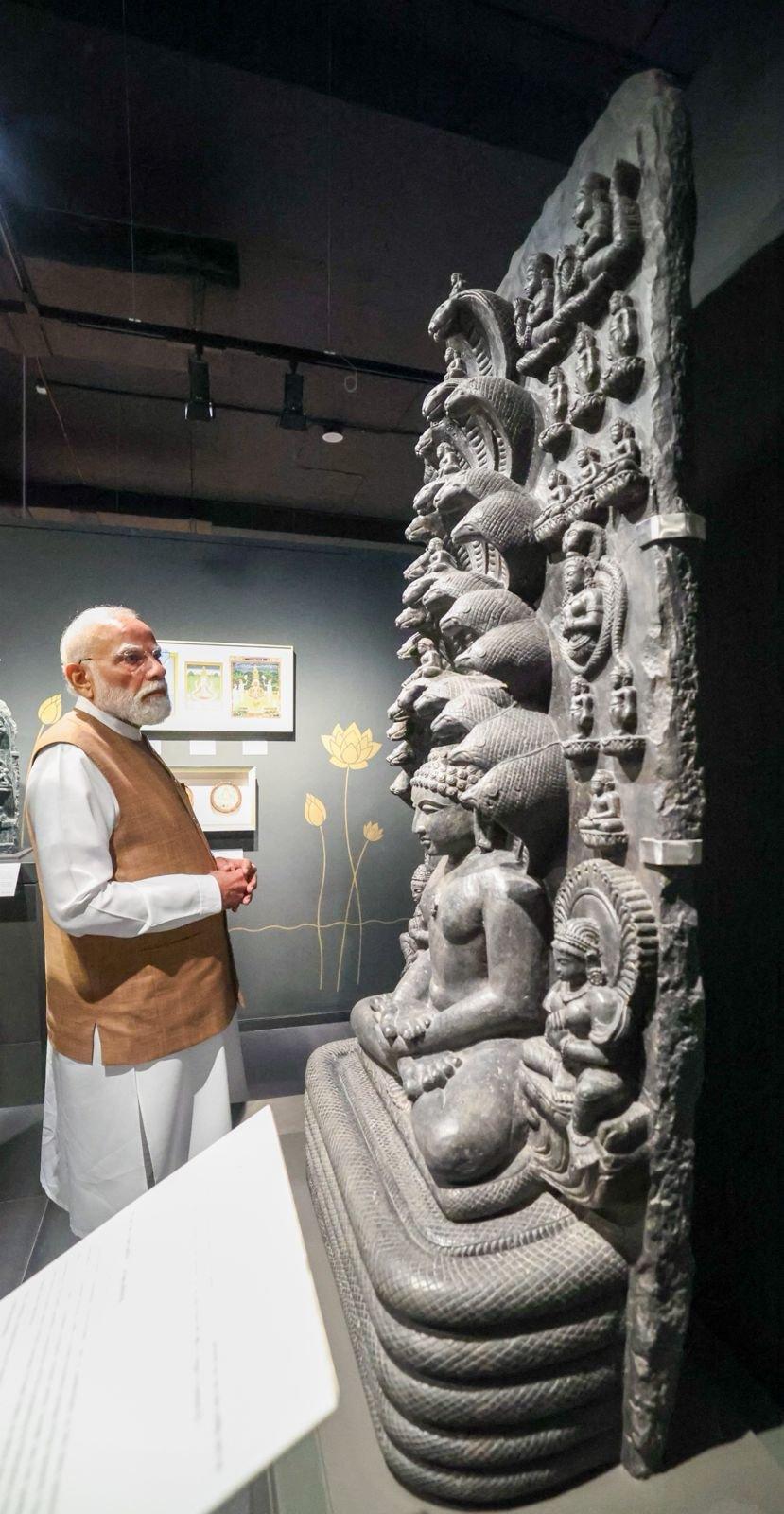
Paperman Media (Ahmedabad)- The Prime Minister, Shri Narendra Modi, today inaugurated the Samrat Samprati Sangrahalay, Jain Heritage Museum at Koba Tirth in Gandhinagar, Gujarat, on the auspicious occasion of Bhagwan Mahavir Jayanti. "Koba Tirth is steeped in spiritual tranquillity, a place where the tapasya of so many Jain Munis and saints finds expression, and where creation and service naturally blossom," said Shri Modi.
Highlighting the enduring traditions of Koba Tirth, the Prime Minister noted that for years, the traditions of study, sadhana, and self-discipline have been flourishing at this sacred site. He underscored that the preservation of values, the nurturing of sanskaras, and the nourishment of knowledge form the triveni , the confluence that constitutes the very foundation of Indian civilization. "Keeping this triveni flowing uninterrupted is the shared responsibility of all of us," affirmed Shri Modi.
The Prime Minister expressed his happiness that the timeless knowledge of Jain Dharma and India's rich heritage are now being preserved for centuries to come through the Jain Heritage Museum, conceived by the saints to present ancient wisdom to the next generation in new and modern forms. "Today, that grand vision has been realized in the form of the Samrat Samprati Sangrahalay , a sacred centre of Jain philosophy, Indian culture, and our ancient heritage," stated PM Modi.
The Prime Minister congratulated all the Jain Munis, saints, and the thousands of devoted individuals who made immense contributions to this endeavour. Underlining the importance of innovation in heritage preservation, he observed that when ancient knowledge is presented in new ways, the heritage is enriched and future generations find renewed inspiration. "The Samrat Samprati Sangrahalay belongs to the crores of people of India and stands as a testament to our glorious past," he remarked.
Dwelling on the historical significance of Samrat Samprati, the Prime Minister observed that while many civilizations produced great thinkers and philosophers, rulers in several parts of the world often abandoned ideals when confronted with the question of power, creating a chasm between thought and governance. He noted that Samrat Samprati was not merely a historical king but a bridge connecting India's philosophy and practice. "In India, rulers like Samrat Samprati treated power as service and sadhana, expanding ahimsa from the throne, and propagating satya (Truth) , asteya (non-stealing), and aparigraha ( non-possessiveness) with utmost detachment and selflessness," Shri Modi asserted.
The Prime Minister noted that the museum has been thoughtfully designed so that every step reveals the grandeur of India, with its seven galleries proclaiming the nation's diversity and cultural richness. He highlighted the first gallery showcasing the Navpad, Arihant, Siddha, Acharya, Upadhyaya, Sadhu, and the four principles of Samyak Darshan, Samyak Gyan, Samyak Charitra, and Samyak Tap and the third gallery, which artistically brings to life the stories and teachings of the Tirthankaras. "When knowledge is samyak ,righteous , it becomes the foundation of equanimity and service," PM Modi observed.
Pointing out that the museum also gloriously represents India's other religious traditions , Vedic, Buddhist, and others alongside Jain heritage, the Prime Minister highlighted India's greatest strength: its diversity and unity in diversity. He noted that while the world has witnessed conflicts in the name of religion and sect, this museum presents all traditions together like a rainbow , Vedas, Puranas, Ayurveda, Yoga, and Darshana standing harmoniously side by side. "This can only happen in India," he affirmed.