

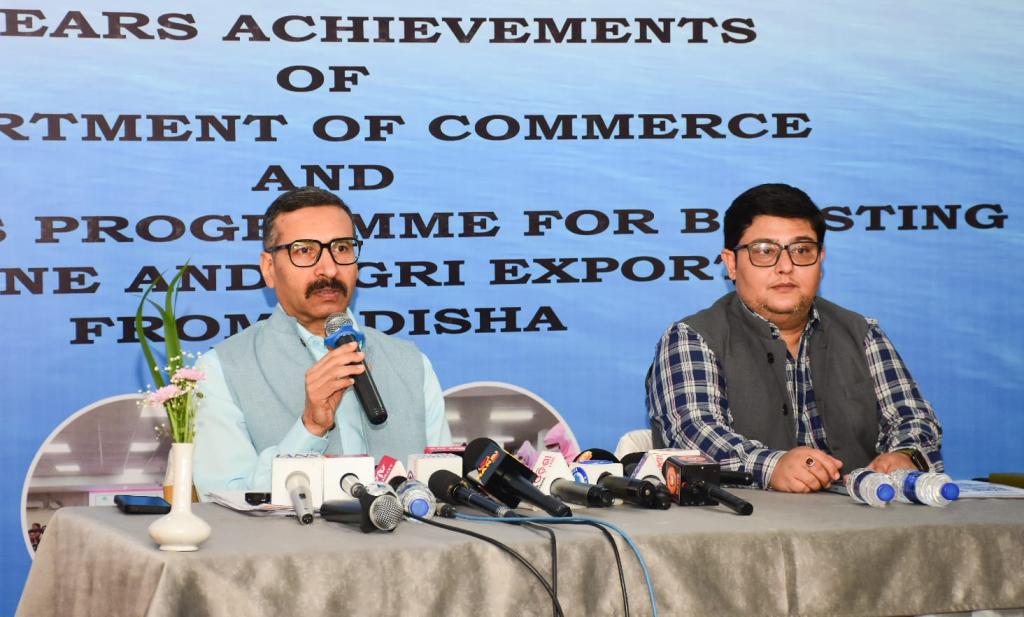
Paperman Media (Bhubaneswar)- Over the last twelve years, the Department of Commerce has played a crucial role in transforming India into a globally competitive trading nation. Inspired by the vision of Hon’ble Prime Minister Shri Narendra Modi to transform India into a “Global Export Hub,” the Department of Commerce has promoted the spirit of “Vocal for Local” and “Local to Global,” enabling Indian products and businesses to expand their presence across global markets. Through policy reforms, digital transformation, trade facilitation, and strategic trade partnerships, the Department has strengthened India’s position as a major player in global commerce and supported the vision of making India a “Global Export Hub.”
India’s exports recorded remarkable growth from FY 2014-15 to FY 2025-26. Total exports increased from US$ 468 billion to a historic high of US$ 863 billion, reflecting a CAGR of 5.7%. Merchandise exports rose from US$ 310 billion to US$ 442 billion, while services exports grew from US$ 158 billion to over US$ 421 billion, achieving a CAGR of 9.3%. Engineering goods, electronic goods, pharmaceuticals, textiles, agricultural products, marine products, and gems and jewellery emerged as major export drivers.
The Department introduced several digital initiatives to improve ease of doing business, including the Trade Connect Portal, Trade Intelligence and Analytics (TIA) Portal, Merchandise Imports. Monitoring Portal (MIMP), e-IEC generation, and online certification systems. These measures enhanced transparency, reduced compliance burdens, and improved access to trade-related services.
India also deepened trade relations through landmark agreements such as the India-UAE CEPA, India-Australia ECTA, India-UK FTA, India-EU FTA, India-Oman CEPA, and India-New Zealand FTA. These agreements expanded market access, reduced tariffs, promoted investment, and strengthened India’s integration with global value chains.
A notable success story has been the growth of India’s marine products sector. Seafood exports reached a record value of USD 8.45 billion in 2025-26, with frozen shrimp accounting for more than 66% of export earnings. The United States and China remained the largest importers of Indian seafood. India’s marine exports have been supported by initiatives promoting quality standards, traceability, infrastructure development, and market diversification.
Odisha has emerged as one of India’s most promising seafood-exporting states. With a long coastline, favourable aquaculture conditions, and strong fisheries infrastructure, Odisha exported 100,897 metric tonnes of seafood valued at USD 623.28 million (₹5,428.67 crore) during 2025 26. The state recorded growth of 9.63% in export quantity and 11.90% in export value over the previous year. Odisha has 64 registered seafood exporters, 45 processing plants, modern cold storage facilities, and 36 shrimp hatcheries supporting aquaculture development. Vannamei shrimp production reached 53,628 metric tonnes during the year.
The state’s fisheries sector is supported by major fishing harbours at Paradip, Dhamara, and Balaramgadi, along with important fish landing centres at Bahabalpur, Balugaon, Chudamani, and Kosia. A significant achievement was the growth of containerized seafood exports through Paradip Port, where container movement increased from 76 to 158 containers, representing growth of over 107%. MPEDA also provided assistance to support infrastructure development and value addition projects in Odisha.
Odisha possesses immense potential for agricultural exports due to its rich natural resources, diverse agricultural production, and growing infrastructure. The state is known for several unique Geographical Indication (GI) products and also has strong potential in the export of cashew nuts, groundnuts, sweet potatoes, mangoes, pineapple, dragon fruits, millets, spices, dairy products, floriculture products, and processed foods. The MITS Mega Food Park at Rayagada provides opportunities for value addition, food processing, and export-oriented industrial development.
The Department of Commerce has further strengthened export competitiveness through initiatives such as the Foreign Trade Policy 2023, Districts as Export Hubs, RoDTEP, RoSCTL, Trade Infrastructure for Export Scheme (TIES), and Niryat Bandhu capacity-building programmes. These efforts have empowered exporters, enhanced infrastructure, and promoted sustainable export growth across sectors and regions. Overall, the achievements of the Department of Commerce over the past twelve years demonstrate India’s growing strength in global trade. Through export promotion, digital transformation, stronger trade partnerships, and sector-specific support, India is well-positioned to achieve the vision of Viksit Bharat 2047 and become a leading global trading power.